21/09/2026
Almin Kaplan: “Those who have been running this country for 30 years do not see culture as important.”
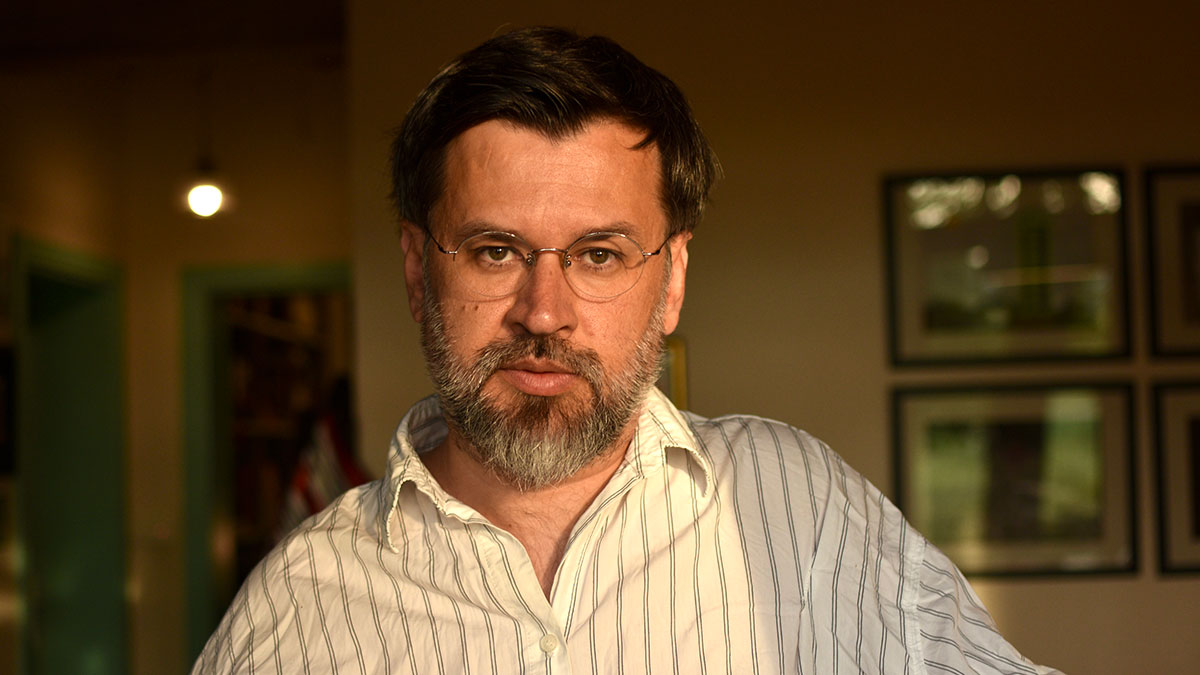
Writer Almin Kaplan is on the jury of the 27th Mediterranean Film Festival in Široki Brijeg, where he and two other members will decide on the best short documentary film. As a writer and a big film enthusiast, Kaplan approaches the festival competition from a unique perspective; he values storytelling, cinematic language, and rhythm, but above all, the work as a whole and the impression it leaves on the viewer. In an interview with Večernji list, he discusses this year's competition, the relationship between literature and film, and his work on the screenplay based on the novel “Šušanj”, as well as the state of culture and the arts in Bosnia and Herzegovina.
This year you are a member of the jury for short documentary at the Mediterranean Film Festival. How would you describe this year’s competition and what intrigued you the most in the selected films?
I still haven’t seen all the films, so my answer will not be complete. What I can say about the films I have seen so far is that, technically speaking, they are all flawlessly executed. However, they sometimes lack a story, or at least, as a viewer, I fail to connect with it within the ten or fifteen minutes the film lasts. Thematically, they are diverse, but all of them are films about the world today, about its troubles.
You approach films both as a film buff and as a writer. When watching films you need to evaluate, what ultimately carries the most weight for you, the idea, the cinematic language, the story, or the feeling the film leaves you with after viewing?
Well, I don't know how much of a film buff I am, I wouldn't dare claim that for myself, I've met film maniacs next to whom I keep quiet about films. But, I love film, it is important to me, and even today, I can still find joy in it like a child. You see, everything you mentioned about the film is significant. A successful film is one where nothing stands out, neither the idea, the cinematic language, nor the story, in a positive or a negative sense; the film is a cohesive whole that resists being broken down into parts.
How important are rhythm, cut, and "editing" in literature to you - what you will show, but also what you will deliberately leave out?
They are very important. Storytelling is not a lavish display of language, but a strictly controlled act of telling a story, with pauses that matter more than what is visible. Sometimes, leaving things unsaid is more powerful than saying them. My friend Igor Borozan, a painter and a poet, taught me about editing in literature. We would sit in his studio, and he would play me excerpts from various musical compositions, choosing the starting and ending points himself, and the music, presented in that way, would affect me differently. Often more powerfully than before. There is an art to knowing when to stop.
Your novel “Šušanj” is now being tranformed into the language of film through a screenplay you are working on with Pjer Žalica. Was it difficult for you to accept that a book, when adapted into a film, must lose certain elements in order to gain new ones?
No, it wasn’t. I knew enough about writing a screenplay to realise that a writer mustn’t insist on authenticity of a novel in the screenplay. And then, my challenge was to move “Šušanj”, to achieve something else by writing that script. I really wanted to create a new work. I was very lucky to write that screenplay with Pjer Žalica, and I learned a lot.
To what extent are you willing to let go of your own text? When the director, actors, and camera begin to create something of their own, where does the author's control end for you?
I don’t have a problem with that. I have the text, the director will have a film, and that is the only right way. There is something unsettling about writers attempting to completely control the interpretation of their texts. It’s like expelling that other artist from the project, in this case the director, without whom the text is just empty words.
You started the Buna publishing house with a group of friends?
There is a lack of publishers in BiH, which is a well-known fact. However, we do not intend to right every wrong; we just want to contribute to publishing, to publish books and authors that we love and who we believe have valuable texts. Besides, it is wonderful to have a publishing house in Mostar once again, right where Ihsan Ico Mutevelić’s “Prva književna komuna” (First Literary Commune) used to be.
Is launching Buna primarily a business venture, a cultural necessity, or a kind of personal conviction that things can change if we take the initiative ourselves?
To be honest, it is primarily a love for books, and a naive love at that, the only kind of love there really is.
When discussing the state of culture in Bosnia and Herzegovina, a lack of funding is often the first thing mentioned. In your opinion, what is the deeper problem – money, institutions, cultural policy, or the fact that culture is often not perceived as something essential to society?
The main problem is that the people who have been running this country for thirty years do not recognize culture as important, and it is, in the long run, the most important. There is money in the country, just look at how a select percentage of the population close to the authorities lives. The political patterns applied in BIH are very primitive and an unenlightened individual is a vital interest. At the expense of the state and everything they swear by, they are just keeping culture alive. It comes to them like that old horse that they don't know what to do with. But we should not forget those in culture who also live well because of this state of affairs. I doubt that they would also change the bad cultural policy, except when some kind of grant slips away and they speak angrily so that only those they are blackmailing can hear them.
Mostar and Herzegovina possess a strong literary and artistic tradition, yet cultural life often relies on the enthusiasm of individuals. Can a serious cultural scene be built without a system to support that enthusiasm in the long term?
Everything that has been happening in Mostar over the last decade or so is interesting. I see that some people are very agitated and unhappy that Mostar has come back to life. And this is precisely thanks to the enthusiasm of individuals. Let's remember that about fifteen years ago, the only visible writers were those close to the authorities, the so-called poets on duty who would be called upon to recite their verses in public places, thus giving them the legitimacy of artists. These are the ones who, on World Poetry Day, would read their verses on public television, with the Old Bridge in the background, or with pomegranates. In the meantime, some nice things have happened, local writers have fought for their place and are now visible. Most of them have good publishers. One of the most important moments for the literary scene in Mostar was when some of our books were published by the publisher from Grude, Ivica Pandžić and his Synopsis publishing house, and Ivan Lovrenović signed on as editor.
Do you feel that art in our country today has enough space to be uncomfortable, critical, and subversive, or is it increasingly expected to be tame, useful, and "acceptable"?
The only imperative of literature is to be good literature. Writers should not be held captive by any narrative, not even one insisted upon by a victim. Hypothetically, should we disqualify a writer who tries to influence an investigative journalist and ask him to remove a person close to him from the list of participants in a criminal affair? We could go on asking questions like this indefinitely, but I would rather not speak about my colleagues in that manner; let the readership decide. Perhaps that hypothetical writer took pity on his acquaintance's mother; perhaps he wanted to put an end to her suffering, sensing how deeply the poor woman had been struck by her son's misfortune.
In your work, you often return to Herzegovina, its people, and their everyday lives. What is it that you have not yet managed to write about this region, but feel is still waiting for you?
To be honest, I feel like I haven't written anything yet, that my writing is still ahead of me. And I suppose that’s a good thing. I am currently working on two film projects, both of which are connected to Herzegovina, more specifically, to Mostar.