24/09/2026
Maude Vuillez: With my film, I am challenging the cliché that deaf people cannot speak
The documentary film “Signs from the Below” by French filmmaker Maude Vuillez will be screened at the 27th Mediterranean Film Festival in Široki Brijeg. It is a deeply personal story that views deafness not as a problem to be solved, but as a part of identity, while exploring themes of belonging, family, love, and the search for one's place in the world.
“Signs from Below” is a very personal film about growing up deaf in a hearing world. What inspired you to tell this particular story?
All my life, I was surrounded by hearing people: family and friends. Then, as I grew up, year after year, I was looking at my own life, wondering: Am I missing something? I went to a festival dedicated to Deaf People: Clin d’Oeil, in Reims, France. I met so many people who became very close to me. I realised how important it is to me to deal with my Deaf Identity. At this time, I was thinking about my movie, so everything’s linked.
In the film, deafness is not presented as a problem that needs to be solved, but as a part of identity. Was it important for you to challenge the usual perception of deafness?
I’m a very talkative person, so voice-over is very strong in the movie. It was important to me to break the cliché of “deaf people can’t speak”. Also, I wanted to make a very colourful film, in a positive tone, without tears or complaining. It’s a way to prove that deafness isn’t a handicap (of course, it can be sometimes because we live in an ableist society), but more than anything, something to rely on.
The title of the film connects sound, silence, and depth. How important was it for you to give the audience a sense of a world that does not rely on the usual experience of sound?
“Signs from below” was a metaphorical way to talk about sign language I discovered while jumping into the unknown of the sea (which is life). French title is “Comme une pieuvre” (like an octopus). If you watch my movie, you will understand the metaphor. My film makes extensive use of sound, whether through sharp breaks in the soundscape or through the evocation of sensations. The idea is not so much to put a hearing audience member in the shoes of a Deaf person, as the degrees of hearing loss vary greatly. Consequently, there is no single way to portray deafness. These experiments with sound encourage hearing people to reflect more deeply on how they listen to the world and gently challenge them whilst they are watching, to draw them out of their comfort zone. Of course, it was important to me, and I had a lot of discussions with my sound team to flesh out the ideas. For example, there’s complete silence in a scene. That is to say, technically, there’s no track on the timeline! I had to “fight” to make it clear that it’s okay: no sound. Yes, no sound at all… no need to fake it.
The film explores identity and the need to belong. Do you think that, despite the differences in experience, the process of growing up and searching for one’s identity is something that a wider audience can relate to?
That’s a good question, and it’s certainly something that pleasantly surprised me. I realised this once the film was finished, when I heard the audience’s reactions. We all have diverse, complex identities, whether it’s a disability, culture, country… For example, I’ve had feedback from adopted people who identified (not with deafness, of course) but with this broader reflection on how to find one’s place in a world that isn’t really our own, and so, perhaps, to feel the desire to reconnect with one’s roots.
How much did making this film change your perspective on deafness and on the way society communicates with deaf people?
This movie opened so many doors I didn’t expect, especially the fact that I became friends with amazing people. Also, I always fought for things like subtitles or accessibility (for example, I work with the “Silence on grimpe!” collective, which advocates for subtitles in films about mountaineering). The more I’m entering the Deaf Community, the more I can see all the things that need to change. Deafness still causes too much concern amongst so-called ‘able-bodied’ people. Do not over-enunciate, do not shout at the person, and certainly do not ignore them… speak to them calmly and ask them what they need. Talk not to a Deaf person but to a person, whilst adapting to their difference – their deafness.
Since you are the film’s writer, director, and editor, how important was having such complete creative control over this inmate story?
At first, everyone told me, “Such a personal subject: it’s risky!” And indeed, so many times I found myself in doubt, struggling to decide what to say. The hardest part was the voice-over. What should I say? How could I retain some sense of privacy whilst opening up so much? Fortunately, I was supported by a brilliant team, particularly the sound team, who helped me take a step back from certain things. But it’s a film about self-reflection, and it’s taught me a great deal. I always say that the process of doing this movie was more than that. A truly reflective experience.
The film has already received several awards, including the Victor Iliu Award and the Prix Emergences de la SCAM. How do you respond to the reactions from audiences and the film community?
To be honest, my film is so personal and verges on the experimental that I really wasn’t expecting such glowing reviews. I thought that hearing people wouldn’t be sensitive to this and that Deaf people would see problems with it. Actually, both deaf and hearing audiences are very receptive to what I have to say, and I’ve had so much feedback from people who can relate to it, that’s amazing. As I said earlier, the film goes beyond the issue of deafness. It explores the themes of identity, family, love, and what it means to grow up… and seeing that the film is being shown in such a wide variety of countries really brings me joy!
What would you like viewers to see or understand differently after watching Signs from Below?
There’s the very personal side to it: listen to yourselves, be honest with yourselves; if you feel out of place somewhere, try to change that. Life is short, don’t take it for granted. And then there’s the more activist side: don’t forget that there are so many different people in the world; don’t be afraid of them and adapt… because they adapt a great deal too.
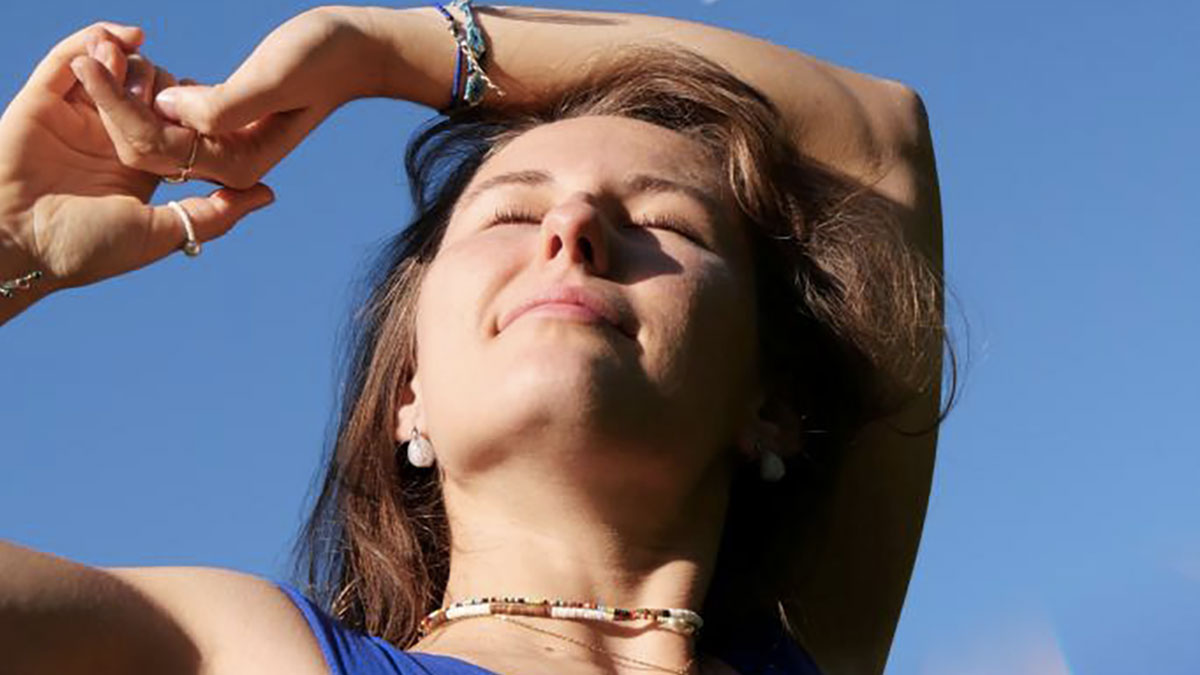
Photo: Cassandra Bonniec